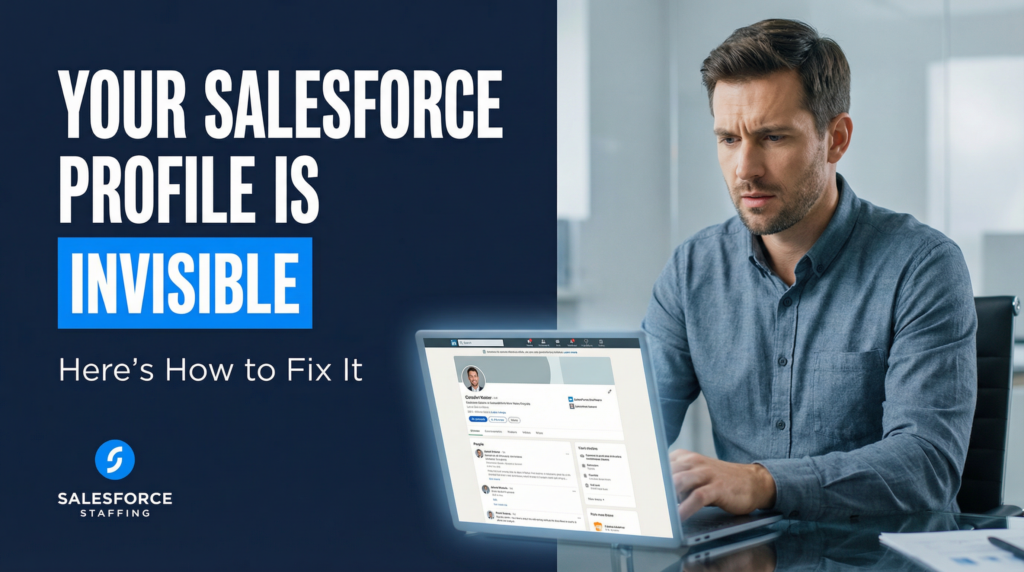
Your Salesforce Profile Is Invisible. Here’s the 5-Minute Fix.
You think your LinkedIn profile is fine. It’s not. It’s a list of certifications and job titles that looks exactly like every other Salesforce professional in the pile — and when a recruiter or hiring manager opens it, they move on in about five seconds. Literally five seconds.
I covered this in depth on a recent episode of The Hiring Edge podcast with Gabbie Caballero and Scott Stafford. We did a live LinkedIn and resume makeover breakdown for Salesforce candidates. What came out of it was practical, honest, and a little uncomfortable — because most people are doing this wrong, and they don’t know it.
If you’re a Salesforce Admin, Consultant, or Architect and you’re wondering why your phone isn’t ringing, this is likely why.
The 5-Second Resume Test — And Why Most Profiles Fail It
Here’s how recruiters actually work: we spend about five seconds on a resume before deciding whether to keep reading. That’s not a complaint — it’s just the reality of volume. My team works from a database of roughly 80,000 Salesforce professionals. We search, we find profiles that communicate value quickly, and we skip the ones that don’t.
That first scan is looking for a few things: your current title, your most recent employer, a sense of the scope of work you’ve done, and one or two signals that you’ve actually moved the needle somewhere. If those things aren’t obvious in five seconds, you’re gone.
Most Salesforce profiles fail this test because they’re built around activities, not outcomes. “Managed flows.” “Configured objects.” “Supported the sales team.” These tell me what you did. They don’t tell me what happened because you did it.
Certifications Get You In the Pile. Impact Gets You the Job.
Certifications matter — don’t misread this. If you’re a Salesforce Admin without your Admin cert, you’ll get screened out fast. But once you’re past that gate, everyone in the pile has certs. Some have eight of them.
What separates the candidates who get called from the ones who don’t is proof that they’ve actually moved something.
“Implemented Service Cloud” tells me nothing. “Implemented Service Cloud for a 200-seat support org and reduced ticket resolution time by 31%” tells me you understand outcomes, you can communicate them, and there’s a real business result attached to your name.
Every bullet on your resume should start with an action verb and end with a result. If it doesn’t end with a result, it’s not finished. Go back and finish it. This is also part of The Orchestrator vs. Builder shift happening in 2026 — the candidates winning are the ones who communicate business impact, not just technical activity.
What Do the Numbers Look Like?
You don’t need a Harvard case study. You need something real and specific. Think in terms of:
- Time saved (“reduced manual reporting time by 40%”)
- Revenue or pipeline impacted (“supported a 12-person sales team managing $8M in annual pipeline”)
- Scale of the implementation (“led migration of 250,000+ records to new data model”)
- Project investment (“architected a CPQ solution for a $400K implementation engagement”)
- Adoption improvements (“increased CRM adoption from 52% to 87% in 90 days”)
Numbers beat fluff every time. Even a rough estimate — “roughly $300K project,” “team of 15 users” — tells a more compelling story than vague qualifiers like “large-scale” or “complex.”
AI Resume Red Flags: When Blending In Costs You the Job
Here’s something most people don’t want to hear: senior hiring managers can often spot an AI-written resume immediately. The formatting patterns, the overly polished sentence structure, the suspiciously consistent bullet length — these are signals.
That doesn’t mean AI is bad. It means using AI to write your story is. AI can help you format, tighten, and polish. But if you feed it a vague job description and ask it to generate your bullet points, what comes out sounds like every other AI-generated resume. You’ve traded your actual story for generic language, and now you’re invisible for a different reason.
Your resume is your story. AI can help you tell it better. It cannot tell it for you.
The Identity Crisis That’s Killing Your Positioning
This one doesn’t get talked about enough: the identity crisis.
A lot of Salesforce professionals are trying to play both sides — presenting themselves as both an independent consultant available for contract work and a full-time job seeker. And I get it. Freelancing pays well. Full-time roles offer stability. You want optionality.
But here’s the problem: when a hiring manager looks at your profile and sees “Founder, [Your Name] Consulting | Salesforce Freelancer | Open to Opportunities,” they’re confused. Are you committed to building your own thing? Are you settling for full-time because the consulting dried up? Are you going to leave the moment a better contract comes along?
Confusion doesn’t convert. It creates doubt.
The “One Thing” Strategy
The fix is simple but uncomfortable: pick a lane.
If you’re seriously pursuing full-time employment, your profile needs to look like someone who wants full-time employment. That doesn’t mean hiding your freelance work — it means reframing it. “Led 14 contract implementations as independent Salesforce consultant” is a strength. “Founder, Josh’s Salesforce Side Hustle LLC” as your current headline is not.
The “one thing” strategy means choosing your primary positioning and making every element of your profile reinforce that one identity. One headline. One About section story. One version of you. Clarity creates confidence in the reader — and confidence gets calls.
Your LinkedIn Headline Is Wasted Space
The default LinkedIn headline is your job title and company. That’s what the platform auto-fills, and most people never touch it.
Your headline is the first thing a recruiter sees in search results. It needs to answer three questions in one line: What do you do? Who do you help? What makes you worth a second look?
“Salesforce Admin at XYZ Corp” answers none of those. “Salesforce Admin | Helping Mid-Market Sales Teams Get More Out of Their CRM | 5 Certs + 8 Years of Implementations” actually gives someone a reason to click.
You have 220 characters. Use them. Every character is an opportunity to tell someone why you’re the one they should call.
The About Section: Stop Leaving Money on the Table
The About section on LinkedIn is the most underused real estate on the platform. Most people either leave it blank, write three sentences, or paste in a version of their job description that reads like it was written by committee.
It should sound like a person talking.
Write it in first person. Tell someone what you’ve built, what kinds of problems you’ve solved, and what kind of work you actually want to do next. Close with something specific — the type of challenge you’re best suited for, the industries you know well, or a direct invitation to connect.
Hiring managers read it. Recruiters read it. If it’s empty or robotic, you’ve lost your best shot at a real first impression before anyone’s even looked at your experience section.
LinkedIn Alignment: Are Your Resume and Profile Telling the Same Story?
This is one that trips people up more than they expect.
Hiring managers cross-check. If your resume says you led a 12-person implementation team and your LinkedIn makes it look like you were a solo admin at the same company, that mismatch creates doubt. Doubt kills candidacies.
Your resume and your LinkedIn profile need to be aligned — not identical, but consistent. Same titles, same dates, same scope. If there’s a difference in how you’re presenting the same experience in two places, one of them is lying. Fix it before someone finds it for you.
What Does “Passive” Actually Mean?
Here’s what most Salesforce professionals don’t think about: if you’re passively open to new opportunities, your LinkedIn profile is actively working for you right now — whether it’s set up right or not.
Recruiters search LinkedIn constantly. I run a Salesforce-only practice and have conducted north of 15,000 interviews. When my team searches for a specific combination of skills and experience, we find the profiles that are built well. The ones that aren’t, we skip over — not because the person isn’t qualified, but because the profile doesn’t communicate it.
Passive doesn’t mean safe. Your profile is a 24/7 job application. Treat it like one. And if you want to know what hiring managers are actually testing for in 2026, that context matters here too.
The Ding-a-Ling Moment
I’ll be blunt: a lot of people use “I’m still updating it” as an excuse to avoid doing the uncomfortable work of actually articulating their value.
Perfectionism is just procrastination with better PR. If you’re waiting until your profile is “perfect” to turn on Open to Work or reach out to a recruiter, you’re letting fear make a career decision on your behalf.
The candidates who get to the top of the pile consistently — regardless of cert count — are the ones who can articulate their impact. They know what problems they’ve solved, they can put numbers around it, and their profile makes that obvious before anyone picks up the phone. That’s not talent. That’s preparation.
Take One Action Right Now
Go to your LinkedIn profile. Read your About section out loud.
If it sounds like a job posting, rewrite it. If it’s empty, start there. Use plain language, first person, and lead with the most interesting or impactful thing you’ve done in the past three years.
Then look at your first three resume bullets. Do they end with results, or just activities? If they’re activities, rewrite them before you send your resume to anyone else.
Two things. Do them today.
Ready to Stop Being Invisible?
If you want a second set of eyes on your resume or LinkedIn profile, or you’re ready to have a real conversation about what your next Salesforce role should look like, reach out to the team at TheSalesforceRecruiter.com. We work exclusively in the Salesforce ecosystem, and we know what it takes to get your profile in front of the right people.
You can also browse open Salesforce roles we’re currently working, or watch the full breakdown on the JoshForce YouTube channel.
Josh Matthews is the founder of Salesforce Staffing, LLC and TheSalesforceRecruiter.com and host of The Hiring Edge podcast. He has been recruiting since 1999, operating Salesforce-only since 2018, and has conducted more than 15,000 interviews.