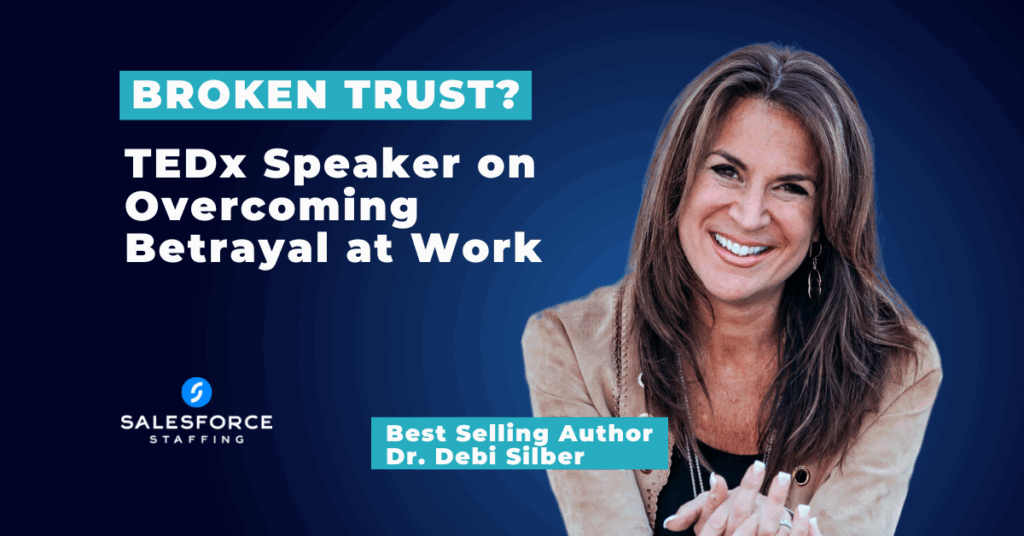
When Trust Shatters: How Betrayal at Work (and in Life) Destroys Performance—and How to Heal
Imagine waking up one morning to find that the colleague you trusted most has taken credit for your work. Or realizing your company has quietly broken promises that convinced you to join. Or maybe you can’t shake the feeling that everyone around you is out to get you—even when they’re not.
Welcome to the world of betrayal in the workplace.
On this episode of The Hiring Edge, I sat down with Dr. Debi Silber—founder of the Post Betrayal Transformation Institute, TEDx speaker, and author of Trust Again. Dr. Silber has made it her mission to help people understand, heal from, and grow beyond betrayal.
And here’s the truth: whether the betrayal happens in your personal life or in the office, you carry it with you to work every single day.
Below, I’ll share some of the powerful insights she revealed about why betrayal is so damaging—and exactly how to move through it.
Why Betrayal Hurts More Than Other Traumas
Dr. Silber discovered in her research that betrayal isn’t just another kind of adversity—it’s its own category of trauma. Unlike loss or illness, betrayal feels intentional. You take it personally because it comes at the hands of someone you once trusted.
That shattering experience doesn’t just break your trust in others—it can fracture your ability to trust yourself.
Think about it: when a loved one dies, you grieve, but you rarely question your judgment or your own worth. When you’re betrayed, you do.
The Hidden Cost of Betrayal in the Workplace
You might think you can compartmentalize your pain. But Dr. Silber shared striking statistics showing how unhealed betrayal infiltrates your work:
- 94% of people deal with painful triggers that hijack focus and emotional energy.
- 84% struggle to trust anyone—even themselves.
- 78% feel overwhelmed.
- 68% can’t concentrate.
- 63% live with crushing fatigue.
If you’ve ever wondered why a top performer suddenly disengages, or why your own drive evaporates after a broken promise, these numbers explain it. Betrayal doesn’t stay in its lane—it shows up in your meetings, your relationships, and your performance.
The Five Stages of Healing Betrayal
While betrayal can feel like a life sentence, it doesn’t have to be. Dr. Silber’s research uncovered five predictable stages of healing:
- Shock and Trauma: The moment of discovery, when everything you believed collapses.
- Survival Instincts: You’re in damage control—numbing, distracting, just trying to function.
- Stuckness: You cling to your story, gather evidence you were wronged, and stay here for years (or decades).
- Acceptance and Adjustment: You decide you can’t change what happened but can choose what to do next.
- Rebirth and Renewal: You rebuild your trust, your health, and your life on stronger foundations.
Most people get trapped in Stage 3—telling the same stories and reliving the same pain. As Dr. Silber said, staying stuck becomes a choice.
Why So Many People Stay Stuck
We often don’t move on because staying stuck offers hidden benefits. We don’t have to risk setting new boundaries, confront the people who hurt us, or face the fear of change.
Dr. Silber shared four questions to help you see if you’re stuck:
- Am I numbing, avoiding, or distracting myself? (And if so, how?)
- What am I pretending not to see?
- What will my life look like in five or ten years if I don’t change?
- What could my life look like if I start healing now?
If you do nothing else, sit with these questions. They’re a mirror many people avoid—but the answers are the first step toward freedom.
When Companies Betray Employees
We often think of betrayal as personal, but organizations do it too:
- Promising promotions that never come.
- Changing compensation structures without warning.
- Publicly supporting employees’ well-being but privately punishing vulnerability.
Dr. Silber calls betrayal “the breaking of a spoken or unspoken rule.” If your company has ever said we’re a family but treated you as disposable, you’ve felt it.
And if you lead people, it’s critical to ask: Am I unintentionally creating betrayal through broken promises or inconsistent leadership?
What Leaders Can Do
If you’re a manager, don’t assume people leave solely for better pay or opportunity. Many exit because they can’t trust you—or the environment you’ve built.
To start changing that, try this:
- Acknowledge the possibility of betrayal without judgment.
- Normalize the conversation: “Sometimes past betrayals can impact how we show up at work. If that feels true for you, you’re not alone.”
- Offer resources—books, assessments, coaching—so people can start healing privately.
As Dr. Silber shared, there’s no shame in acknowledging the wound. The only tragedy is ignoring it.
Transformation is Possible
Betrayal can feel like the end. But as Dr. Silber says, “Trauma is the greatest catalyst for transformation.” You get to decide whether you’ll stay stuck in survival or use the pain to build something stronger.
Even though it happened to you, it’s not about you.
If you’re willing to do the hard work of healing, you don’t have to carry the damage forward into every job, every team, every relationship.
Learn More and Take Action
If you want to learn more about Dr. Debi Silber’s work, her book Trust Again and her newest guide The Betrayal Recovery Roadmap are powerful starting points. You can also take her Post Betrayal Syndrome assessment to see exactly where you stand.
And if you lead a team, consider how you can create an environment where people feel safe, trusted, and supported to heal.
Because in the end, no business can thrive on broken trust.
Thanks for reading.
If you found this valuable, subscribe to The Hiring Edge podcast for more insights on building teams that last—even in the age of AI and uncertainty.