“Slow to Hire, Quick to Fire”: The Operating System Behind Great Teams
Most companies hire too fast, fire too slow, and then wonder why they’re stuck in the minors.
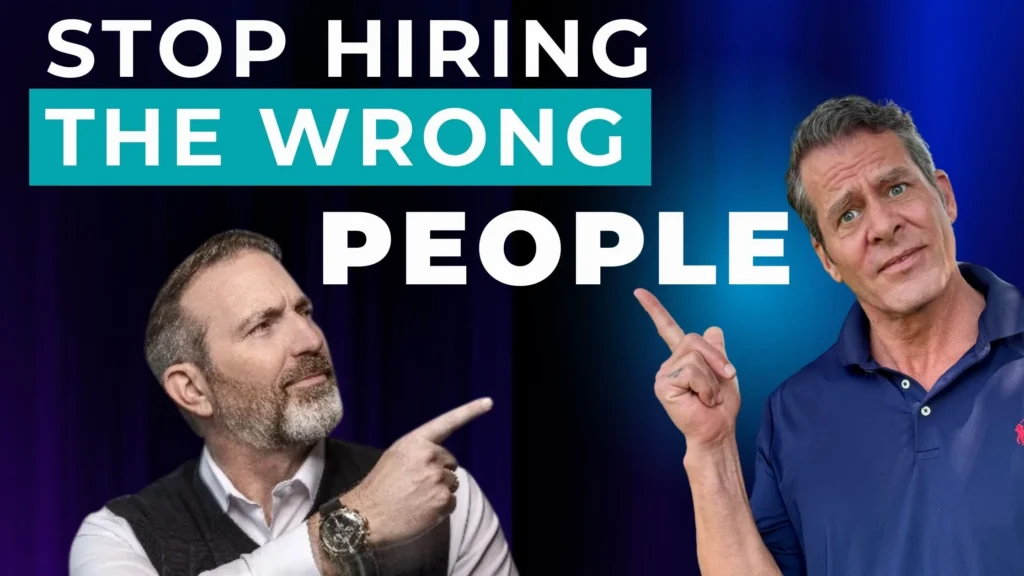
That’s not an opinion. It’s a pattern I’ve watched play out across hundreds of companies over 25 years of recruiting. And in a recent episode of The Hiring Edge — Season 3, Episode 80 — I sat down with someone who’s built his entire coaching practice around breaking that pattern.
Chris Hallberg is a military veteran, author of The Business Sergeant’s Field Manual, and one of Inc. magazine’s top 10 business coaches. He calls his firm BizSgt, and he brings a soldier’s clarity to a problem most companies treat like art: how do you build a team that actually performs?
What came out of our conversation was one of the most direct, practical discussions about hiring and leadership I’ve had on this show. This post covers the core of it.
“All a Company Is, Is a Curation of Humans”
That’s a Chris Hallberg line, and it’s worth sitting with for a second.
Not your product. Not your brand. Not your technology stack. Your company is, fundamentally, a collection of people you have chosen to let in. Every hire is a curation decision. Every mis-hire is a failure of curation.
That framing changes the way you think about recruiting. If hiring is curation — not desperation — then the bar has to stay high even when the seat has been open for three months. Even when the pressure is intense. Even when your team is stretched thin and someone is screaming at you to just fill the role.
The companies that build great teams treat every hire like they’re building a collection. They’re selective, they’re patient, and they know exactly what they’re looking for before they start looking.
The companies that stay stuck hire from desperation — and then spend the next year managing the consequences. This is also why gut-feel hiring is how you stay stuck.
What Does “Slow to Hire” Actually Mean?
It’s not a slogan. It’s a system.
Slow to hire means you’ve defined the role in terms of output, not just activity. It means you know what “great” looks like in the seat before you post the job. It means your process is built to surface the right people — not just the available people.
And here’s the counterintuitive part: when you build that system, you actually interview less. Chris talked about how using the right assessments up front — before the interview stage — can cut your interview volume by 50% while increasing your hire rate by 200–300%.
Think about that for a second. Half the interviews. Two to three times the quality. That’s not magic. That’s process.
Are You Using Assessments, or Just Collecting Data?
Most companies that use personality assessments aren’t really using them. They run the assessment, get a report, and then ignore it when the candidate comes in for the interview and seems charming and confident.
Chris makes a sharper distinction. The goal isn’t just to understand someone’s personality. It’s to identify their wiring — the natural patterns that make them successful in certain environments and unsuccessful in others.
An assessment done right narrows the field before you spend time on interviews. You’re not trying to screen people out unfairly. You’re trying to ensure that the person you’re putting in that seat has the natural patterns that match what the role actually demands.
When you use assessments that way — as a filter before the interview stage, not a box to check after — you spend far less time on candidates who aren’t a fit. You go deeper, faster, with the ones who are. And your hire rate climbs dramatically.
The assessment isn’t the science. The way you use it is.
Are Panels Helping You Hire — or Helping You Hide?
This one hits close to home for a lot of organizations.
The panel interview has become the default at most companies of a certain size. It feels safe. It feels thorough. It feels like you’re distributing the risk of a bad hire across multiple opinions. But what it often does is dilute accountability and penalize great candidates who perform differently in front of committees than they do in real work environments.
Chris is direct about it: the hiring manager needs to have final say. Not the committee. Not the consensus vote. The person who will actually manage the hire, live with the consequences of the decision, and be accountable for the outcome — that person needs to own the call.
Committee hiring creates a convenient place to hide. If the hire goes wrong, it was “the process.” If the process is diffuse enough, no one is really responsible.
Ownership hiring is different. You put your name on it. You made the call. That accountability changes how seriously you take the upfront work — the role definition, the assessment, the interview.
As Chris puts it: a black belt doesn’t take advice from a white belt. If the hiring manager knows the role, the team, and the bar — they need the authority to act on that knowledge.
Why “Quick to Fire” Gets a Bad Reputation It Doesn’t Deserve
The phrase makes people uncomfortable because they imagine impulsive, punitive management. That’s not what Chris is talking about.
Quick to fire, done right, is a direct function of having systems and accountability in place. When your expectations are clear, your onboarding is structured, and your standards are documented — you know relatively quickly whether someone is going to make it. You’re not guessing. You’re not hoping things improve. You have a scorecard.
When performance doesn’t meet clearly communicated standards, and you’ve given someone the tools, the support, and the time to demonstrate what they can do — and it isn’t working — holding on longer doesn’t help anyone. It doesn’t help the team. It doesn’t help the person. And it doesn’t help the company.
The discomfort of letting someone go quickly is much smaller than the cost of carrying a poor performer for 12–18 months because no one wanted to have the hard conversation.
Quick to fire isn’t cruelty. It’s clarity.
Major League Mindset: Are You Playing in the Minors?
Chris uses what I think is one of the best metaphors in this conversation: the difference between bush league and major league leadership.
Bush league isn’t about skill level. It’s about standards. It’s about whether you’re willing to do the real work — the documentation, the role definition, the hard conversations, the accountability structures — or whether you’re taking shortcuts and calling it “culture.”
Major league means you hold yourself and your team to a standard that’s actually worth holding. You build processes that a world-class organization would recognize as sound. You make decisions based on data and structure, not just comfort and consensus.
This applies directly to hiring. Most companies do bush-league hiring. They write job descriptions that are vague, run interviews that are disorganized, make decisions by gut feel, and then wonder why the results are inconsistent.
World-class requires world-class choices. At every step.
What Is Culture Theater — and Are You Performing It?
Culture theater is when you talk about values, post them on the wall, put them in the employee handbook — and then make decisions that contradict them without blinking.
Chris is blunt about this: real culture is what happens when no one’s watching. It’s the decisions made under pressure. It’s whether accountability is applied consistently or selectively. It’s whether the people who represent your stated values get rewarded, and whether the ones who undermine them face consequences.
A lot of companies have great branding around culture. Far fewer have the hard infrastructure underneath it.
This connects directly to what Patrick Lencioni laid out in The Five Dysfunctions of a Team — a framework Chris references throughout the conversation. The foundation isn’t results. It isn’t even accountability. It’s trust. Without trust, you can’t have productive conflict. Without productive conflict, you can’t get real commitment. Without commitment, accountability is performative. And without accountability, results are unreliable.
You can’t skip to accountability and culture if you haven’t built trust first. That’s not a soft HR principle. That’s operational reality.
Moneyball for Teams: The Science Side of Hiring
Chris describes his approach as Moneyball for teams — using data, assessments, scorecards, and structured role definitions to make better decisions more consistently than the competition.
The sports analogy isn’t accidental. Great teams don’t just go with their gut on every draft pick. They have frameworks. They have metrics. They know what positions they need, what attributes predict success in each position, and how to evaluate candidates against that model — not just against how they feel in an interview.
In practice, this means:
- Scorecards tied to role outputs, not just activities. What does success look like in 30, 60, and 90 days? What does it look like at 12 months?
- Assessments that identify natural wiring, not just personality labels. Are they wired to sell? To manage complexity? To hold structure in ambiguity?
- Job ads that repel as much as they attract. If your job post describes the ideal candidate in vague, flattering terms, you’ll get a flood of applicants who saw something aspirational. If it’s direct about what the role actually demands — including the hard parts — you’ll get fewer applications from people who are a genuine fit.
Write job ads that repel. The people who stay interested after reading the honest version are exactly who you want to talk to. This also ties directly into building roles defined by outcomes rather than personalities.
Scale Simplicity, Not Complexity
One of Chris’s core operating principles: when companies grow, they default to adding complexity. More processes, more layers, more systems, more meetings.
The leaders who build great teams do the opposite. They scale simplicity. They figure out what the smallest, clearest version of the operating model is, and they hold the line on that as they grow. They resist the pull toward bureaucracy and committee and process-for-process’s-sake.
This applies directly to hiring. The best hiring systems aren’t complicated. They’re disciplined. Clear role definition. Consistent assessment. An accountable hiring manager. A structured onboarding period. Clear standards and scorecards. That’s it. You don’t need a 14-step process managed by a committee of six.
Simplicity scales. Complexity compounds. Pick one.
The Bottom Line for Founders and Hiring Leaders
If you’re running a company — or running the people function — the core message from this conversation is hard to argue with: you cannot build a great company with a mediocre team, and most teams are mediocre because of how they were hired.
Slow to hire, quick to fire is not a HR policy. It’s an operational philosophy. It means you take the front end seriously — the definition, the assessment, the process — so that the back end (terminations, performance management, re-hiring) is rarer and faster when it does happen.
The companies that do this well interview less, hire better, and fire faster. They run leaner teams with higher output. And they don’t spend months carrying poor performers because no one had the courage or the clarity to act. These same principles apply directly to talent quality and team composition risks in your Salesforce org.
World-class organizations make world-class choices. Start with the hire.
Want to Build a Hiring System That Actually Works?
If this conversation resonated and you want to apply these principles to your Salesforce or B2B team, let’s talk. At Salesforce Staffing, LLC, we help founders and hiring leaders build teams intentionally — not out of desperation.
Listen to the full episode — The Hiring Edge S3E80 with Chris Hallberg →
Schedule a conversation about building your hiring system →
You can also find Chris Hallberg and his work at BizSgt.com and in his book, The Business Sergeant’s Field Manual.
Josh Matthews is the founder of Salesforce Staffing, LLC and TheSalesforceRecruiter.com and host of The Hiring Edge podcast. He has been recruiting since 1999, operating Salesforce-only since 2018, and has conducted more than 15,000 interviews.